
Automated Fastening for Robotic Screw Fastening Cell for Notebook Keyboards
Automated fastening cell for notebook keyboards, designed around 120 UPH throughput, sub-26-second cycle time and digital torque traceability.
See how we designed this project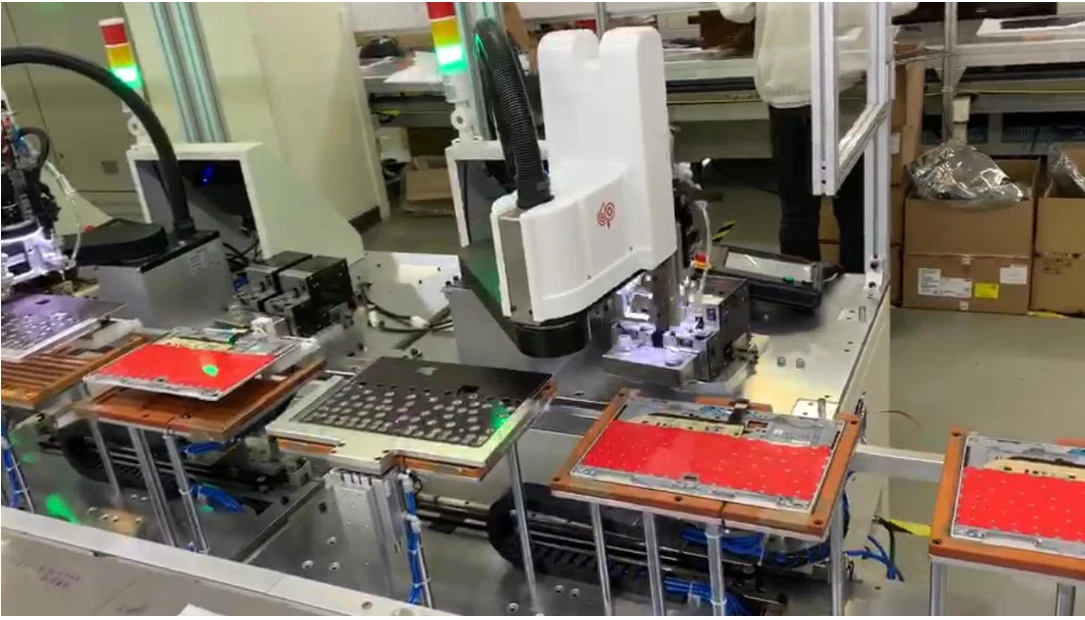
Project Snapshot
- Client Type
- Notebook Keyboard Manufacturer
- Timeline
- Not specified in project
- Deliverables
- Five-station inline fastening plan
- Vision-guided screw fastening robot
- Transfer and product fixture mechanism
- Digital tightening monitoring software
Background
We designed a notebook keyboard assembly process that needed inline robotic screw fastening for 14-inch and 16-inch products. Each keyboard required 42 M1.2 x 1.5 screws with a torque range of 0.1 to 2.0 +/- 0.05 kgf.cm. That makes the scope an automated fastening application for screw fastening.
The line target was 120 UPH, a cycle time within 26 seconds, 99.8% fastening yield and 0.2 mm floating-height control according to screw length.
Challenge
The customer needed to fasten 42 M1.2 screws per notebook keyboard while keeping an inline equipment layout and maintaining product compatibility across 14-inch and 16-inch variants.
The process also needed torque control, screw-by-screw result traceability and enough cycle-time margin to stay within the 26-second CT target.
Approach
- Planned five inline fastening cells, with each cell responsible for 9 screws. we estimate 6 seconds for transfer, 1.5 seconds for imaging and 18 seconds for fastening, for a total of 25.5 seconds.
- Designed the fastening sequence around product arrival detection, cover pressing, two vision capture positions, screw pickup and screw fastening before releasing the product to the next station.
- Integrated a screw feeding system, transfer mechanism, product fixture and press-cover mechanism around the robotic fastening station.
- Used an intelligent electric screwdriver module with vision positioning, displacement sensing, vacuum pickup, +/- 5% torque accuracy and torque-curve recording.
- Included production monitoring software to display tightening results, analyze NG data and show torque, turns and fastening status for each screw.
For a fuller walkthrough of how we planned the inline station split, cycle-time balance and fastening traceability logic, see our notebook keyboard screw-fastening design article.
Outcome
The proposed cell replaces repetitive manual screw fastening with a controlled robotic process while keeping the line inline and digitally traceable.
The solution is designed to improve productivity, reduce operator load and give production teams adjustable fastening parameters, screw-level process data and clearer quality consistency across notebook keyboard assembly.
Project Feedback
Share a short review of this case study or tell us what kind of automation project you want to compare it with.
No published reviews yet.